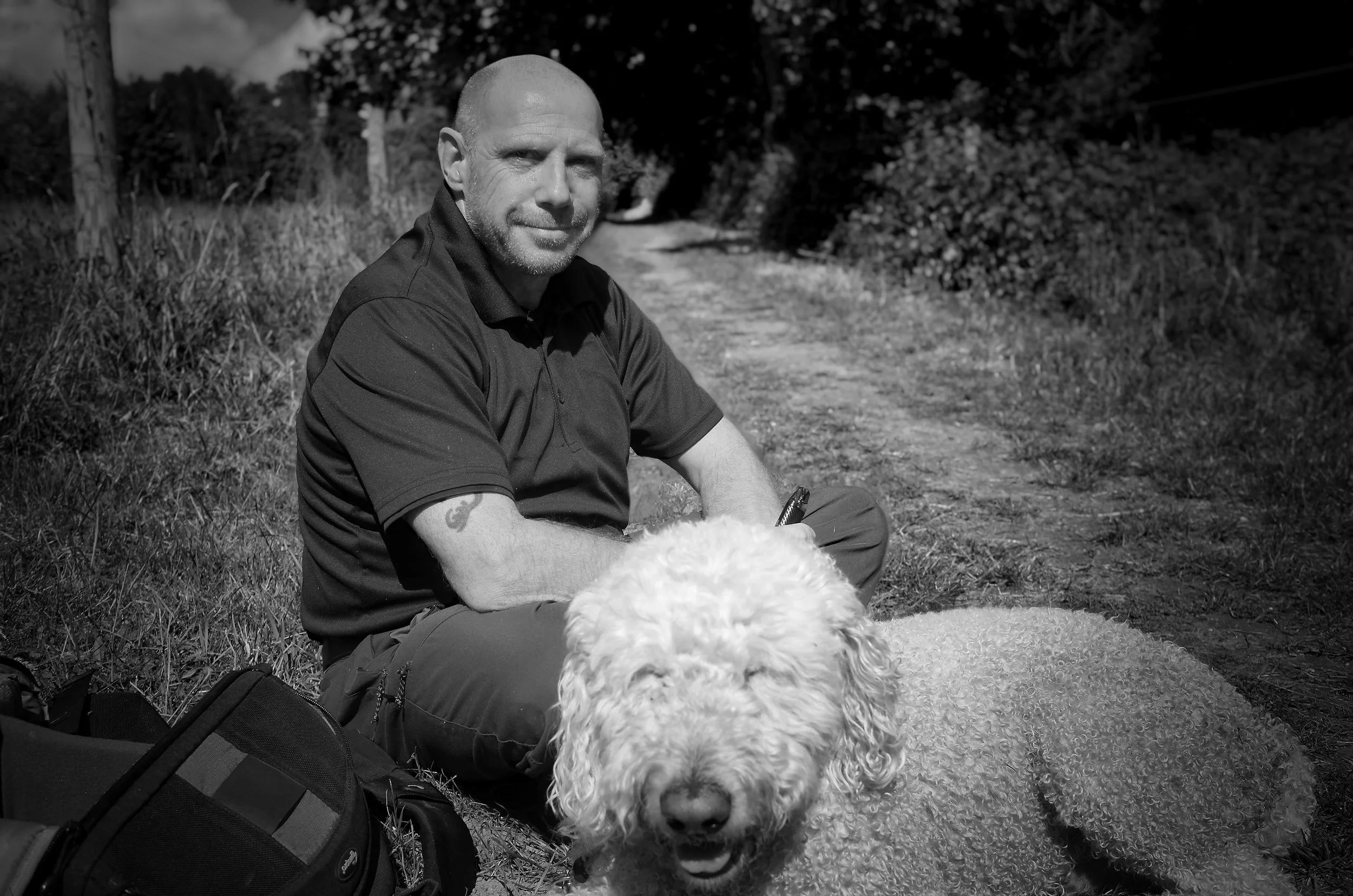
I'm Mark Weekes — a UK black and white landscape photographer based in the Chiltern Hills, Buckinghamshire.
I'm a Cornishman. My family is Cornish as far back as I can trace, and that part of me has never really left — even if I have.
We moved frequently when I was young. My dad served in the military, which meant coastal paths one year, mountain trails in Wales the next, time in the Swiss Alps when we lived in Germany. Being outdoors was never a hobby. It was just how life worked.
That stayed with me. Walking became the constant — something that cleared my head and put me somewhere I wanted to be. It didn't need much justification beyond that.
These days most of my walking is done in the Chiltern Hills, usually with Elvis for company. He's a large white goldendoodle with an uncanny ability to stop complete strangers in their tracks — nobody sets out to make a fuss of him, but somehow they always do. He's become as much a part of the site as the photography, and honestly, on the days when motivation is harder to find, he's the reason we're out at all.
Photography was always in the background, just never the point. A Polaroid Landranger one Christmas when I was about nine or ten. A few hand-me-downs from my dad. A Praktica SLR bought with wages from my first job — used mainly for school trips and family occasions, nothing more deliberate than that. In my early twenties I carried a small point and shoot digital on hikes in the Black Mountains and Brecon Beacons. Documentation, not art.
It wasn't until my mid forties that I decided to take it seriously. I'm now in my mid fifties. What changed wasn't the equipment or the opportunity — it was the intention. The camera was always there. I just finally gave it my full attention.
Writing came the same way. What started as short notes to go with images gradually became something longer — reflections on returning to the same places, on why everyday rural England deserves the same attention as anywhere else, on what walking and photography actually do for you when life is pulling in other directions. I didn't plan to become a writer. I just kept writing until it was obviously part of what I did.
My first book, More Than a Pretty Picture — Finding Peace, Purpose and Creative Sovereignty Through Photography, was published in 2026. A series of four books on the Chiltern Hills is in development alongside it. The books feel like the natural end point of everything the site has been building toward — not a separate project, but the same one at a different scale.
Walking With Pics is built around the Chiltern Hills, Buckinghamshire, and the wider English countryside. Black and white photography, proper walking routes, and writing that tries to do justice to landscapes most people drive past. I've been based here long enough now to know this place in real depth — and there's still plenty left to find.
— Mark