What Nobody Tells You About Building a Photography Website.
You've just finished watching the latest video from one of your favourite creators and they were sponsored by Squarespace. They've told you how easy it is to get your own website up and running — normally within a few hours. It's not the first time you've heard it, and it's not the first person you've seen mention it either, and it won’t be the last. It's planted that idea in your head. "I want a website." Maybe even "I need a website." You've spent a while convincing yourself, but have you actually stopped and asked — is it worth it? Is it really that easy?Is it really what I need?
In short, yes, it can be that easy to get something live. It might take a little longer than a couple of hours, but the more important question isn't how quickly you can build it. It's this: what is actually involved in creating a website that is meaningful, fit for purpose, and worth both the financial outlay and your time? One that will actively attract visitors rather than just sit there quietly gathering digital dust.
The top section of my homepage.
I'm not writing this to put you off — or maybe I am. What I'm hoping to achieve is giving you a clear, honest picture of what's actually involved before you commit. Not the version you see in a sponsored video. The real version.
I've been into landscape photography for many years. A few years back I dabbled with a website that, if I'm being honest, was probably just throwing money away. I didn't take it seriously enough and it showed. Fast forward to 2026 and things have changed. I'm already self-employed — have been for around twenty years — with full-time work that has nothing to do with photography. Photography has always been a hobby and a bit of a sideline, but circumstances changed last year and I had to declare it as a second business. That meant building a proper website, one I could actually stand behind.
After weighing up my options for what I needed, I did eventually go with Squarespace — the very platform you've probably seen sponsored in those videos — at just under £30 a month for the ‘Core’ plan. My reasoning was simple. I wanted one creative space for my work with the option for online sales. I walked away from social media years ago. No Facebook, no Instagram, no X. I was only posting images to Flickr and occasional videos to YouTube. A website felt like the right move. Yes, there's a monthly subscription involved, so in some respects you could argue I'm still renting space, but the difference is I'm in control — my content, my design, my rules, with no algorithm deciding whether anyone gets to see it.
Squarespace’s pricing page.
So here I am, four months in. What follows is a mix of my own experience and extensive research — blogs, forums, industry data, other photographers' accounts — to give you an informed view before you take the plunge yourself. I'll also say upfront that while social media can help drive traffic to a website, I've chosen to stay completely social media free and rely entirely on organic search traffic. I have a five year plan mapped out. More on that later.
Let's Start With the Uncomfortable Truth
The vast majority of photography websites are, to put it bluntly, pointless. Not pointless in a cruel way — most are built with genuine enthusiasm and good intentions — but pointless in a practical sense. They attract little to no traffic, generate no income, and within a year or two are quietly abandoned. Studies suggest that over ninety percent of all web content receives zero organic traffic from Google. Zero. Not a trickle. Nothing.
That's not a reason to never build a website. But it is a very good reason to go in with your eyes open.
The Squarespace Effect
There's a direct line between YouTube sponsorships and the number of photography websites that appear and disappear each year. Top creators who have a big number of subscribers, have an enormous reach. A single sponsored video with 100,000 views can realistically drive hundreds of people to start a trial. Smaller, more specialist creators often see even higher conversion rates because their audiences are actively looking for exactly this kind of tool.
There's nothing wrong with any of that. Squarespace is a perfectly good platform — I'm using it myself. The problem isn't the platform. The problem is the gap between what a sponsored video advert shows you and what building a meaningful website actually requires. Viewers see a polished, professional-looking site and assume that's what they'll have in a few hours. And technically, yes — you can have something that looks decent fairly quickly. But looking decent and functioning as a genuine business asset are two completely different things, and nobody in a sponsored video is going to tell you that.
Squarespace Homepage.
A Saturated Market Before You've Even Started
Landscape photography is one of the most popular photography specialisations there is. The barriers to entry have never been lower — cameras are more affordable, editing software is accessible to everyone, and smartphones in 2026 produce images that would have seemed extraordinary ten years ago. The result is a market absolutely flooded with talented people all trying to do the same thing.
This isn't meant to discourage you from picking up a camera. It's meant to make you think carefully about what you're actually trying to achieve with a website. If your plan involves selling prints, licensing images, or generating any kind of income, you need to understand what you're walking into.
Stock photography, once a reliable income stream for photographers, has largely collapsed as a viable option for most people. The rise of free image libraries — platforms where businesses can download high-quality photographs at no cost — has gutted the paid stock market. Even skilled, experienced photographers struggle to generate meaningful income from stock in 2026. If that was part of your business plan, it's worth revisiting.
Print sales face similar pressure. There is still a market for quality prints, but it's a competitive one and the economics can be brutal. Printing costs, framing, packaging and shipping eat into margins quickly, and you're competing with everyone else who has had the same idea. The honest reality is that for most photographers, print sales alone will not sustain a business — and an online shop that has never sold a single item, which describes the majority of photography website shops, adds nothing except the appearance of a business.
AI: The Elephant in the Room
You can't write about the future of landscape photography without addressing artificial intelligence, and I'm not going to pretend it isn't a factor.
AI-generated imagery has reached a point where the results are, in some cases, almost indistinguishable from actual photographs. Landscapes that don't exist, in perfect light, at the ideal moment — produced without a camera, without travel, without any of the effort that goes into capturing the real thing. For commercial use cases, where a client simply needs an attractive landscape image for a brochure or a website, AI is already a serious competitor to traditional photography.
Just to prove a point, the elephants were added for authenticity as everyone knows we have wild elephants here in the Chiltern Hills.
What AI can't replicate — at least not yet — is authentic human experience. The story behind an image. The fact that you stood in that field at six in the morning in November, soaking wet, because you'd been watching how the light moved across that particular valley for three years. That authenticity has value, but only if you're communicating it. A website that shows images without context or personality is vulnerable. A website built around a genuine voice and a real body of work is in a stronger position.
The Reality of Building Something That Actually Works
Here's where most people get a shock. Building a photography website that functions as a real business tool — not just a digital portfolio that sits there looking pretty — is not a weekend project. It's not even a month-long project.
Realistic estimates put the initial build for a properly planned, content-rich website at somewhere between twelve and sixteen weeks of serious effort. That means researching keywords, mapping out what pages you need and why, writing original content that actually gives visitors a reason to be there, and building the kind of structure that search engines can make sense of. That's before you've even thought about ongoing maintenance.
And it doesn't stop once you've launched. A website needs consistent attention. Content needs to be added regularly. Performance needs to be monitored. When things aren't working, you need to understand why and do something about it. One estimate I came across suggested that writing fifteen high-quality, properly optimised blog posts requires roughly thirty hours of work. That gives you a sense of the scale involved.
A screenshot of this blog being created.
For photographers running their websites as a serious endeavour, the split between creative work and everything else is often eye-opening. Some estimates suggest that as little as twenty percent of the time goes on actual photography — the other eighty percent is writing, editing, SEO, AEO, analytics, administration, and the hundred other things that keep a website functioning and growing. If that sounds exhausting, that's because it is. Most people who start a photography website with vague intentions of turning it into a business don't fully reckon with this until they're already in it.
To put that into some kind of personal context — I've been putting in roughly thirty to forty hours a week on my site most weeks since I started, sometimes more. I'm in the fortunate position of being able to work on it during my regular job, which makes that level of commitment possible. If I were relying solely on evenings at home, it would be a fraction of that time and frankly it wouldn't be sustainable. And to be clear about what those hours actually cover — updating galleries, creating and updating pages, writing blogs, working on my books, SEO, analytics, all the background work that keeps things moving. That figure doesn't include a single hour spent out with a camera. Not one.
The SEO Problem Nobody Warns You About
Search engine optimisation is the process of making your website visible in Google search results. Without it, your website is essentially invisible to anyone who doesn't already know it exists. And so you know — it takes time. A lot of time.
New websites go through what's often called a sandbox period, where Google essentially withholds meaningful rankings while it assesses whether the site is going to be around for the long term. For the first three to six months, organic traffic is likely to be near zero regardless of how good the content is. This catches a lot of people off guard. They build something they're proud of, publish it, and then wait for visitors who don't come.
But SEO is only part of the picture now.
One area that often gets completely overlooked is image optimisation. Every image you upload to your website should have a descriptive file name and alt text — the short written description that tells Google what the image actually shows. Most people upload images straight from their camera with filenames like DSC_4721.jpg and leave the alt text completely blank. From Google's perspective that image is invisible. A filename like chiltern-hills-autumn-beechwood-morning-light.jpg and a clear, descriptive alt text not only helps your images appear in Google image search, driving additional traffic, but also reinforces the relevance of the page they're on. It takes an extra thirty seconds per image and almost nobody bothers — which is exactly why it's worth doing.
AEO — The Thing You Need to Know About Right Now
While you're getting your head around SEO, there's something else worth understanding because it's becoming just as important, possibly more so. It's called AEO — Answer Engine Optimisation — and if you haven't heard of it yet, you will.
You've probably noticed that when you type a question into Google, you don't always click a link anymore. The answer just appears at the top of the page, pulled from a website Google has decided is the most authoritative source on that topic. You got what you needed without visiting anyone's site. That's an answer engine doing its job — and it's exactly how AI-powered tools like ChatGPT, Google's AI Overview, and similar platforms work too. People ask a question, they get an answer, they move on.
AI overview example for a search term, showing AEO in action.
This changes things. Traditional SEO was about ranking high enough that someone clicked your link. AEO is about being the source that gets quoted when no link gets clicked at all. It sounds counterintuitive — why would you want to give the answer away for free — but being cited as a trusted source builds authority, and authority is what drives people to seek your site out directly rather than stumbling across it.
For photographers, this is genuinely relevant. Someone asks an AI tool "what's the best time of year to photograph the Chilterns" or "what camera settings should I use for black and white landscape photography" — if your content is structured clearly enough, factual enough, and written with enough authority, you become the source that gets referenced. Google's AI Overview has already started doing exactly this with well-structured photography and travel content.
The practical difference between SEO and AEO comes down to how you write. SEO is partly about keywords — making sure the right words appear in the right places. AEO is about answering questions directly and completely. Clear headings that mirror the questions people actually ask. Straightforward answers that don't bury the point in three paragraphs of preamble. Content that a machine can read, understand, and confidently pull from because it's unambiguous.
The good news is that writing well for AEO and writing well for SEO are not in conflict. If your content is genuinely useful, clearly structured, and written by someone who actually knows what they're talking about — rather than scraped together from other sites and padded out to hit a word count — it serves both. The days of gaming search engines with keyword stuffing and thin content are long gone. What works now is exactly what should have always been the goal: writing something worth reading, about something you actually know.
The eight-month mark is often cited as the point where consistent blogging begins to generate reliable traffic. Two years is roughly when Google starts to trust a domain enough to rank it competitively. The five-year mark is where the real payoff tends to come — if you've done the work consistently and haven't given up.
My own site is four months in. The trajectory is positive — impressions are growing, click-through rates are improving, and I'm beginning to see the results of the SEO and AEO work I've put in. But I went into this knowing the timeline. Most people don't, and the gap between expectation and reality is exactly where the abandonment happens.
Understanding Your Website Performance — And Not Going Mad in the Process
Building a website is one thing. Understanding how it's actually performing is another thing entirely, and for most people it's where the wheels start to come off.
Google provides two free tools that between them give you a remarkably detailed picture of what's happening with your site. Google Search Console and Google Analytics. Both are worth setting up from day one — not because you'll understand everything immediately, but because they start collecting data the moment they're connected, and data you don't have can't be analysed later.
Google Search Console is primarily concerned with how your site appears in Google search. It tells you which pages have been indexed, which haven't, and why. It shows you what search terms people typed into Google before clicking through to your site, how many times your pages appeared in search results, what position they ranked at, and what percentage of people who saw them actually clicked. It also flags technical issues — pages Google can't crawl, errors, pages accidentally blocked from search — that could be quietly damaging your visibility without you ever knowing.
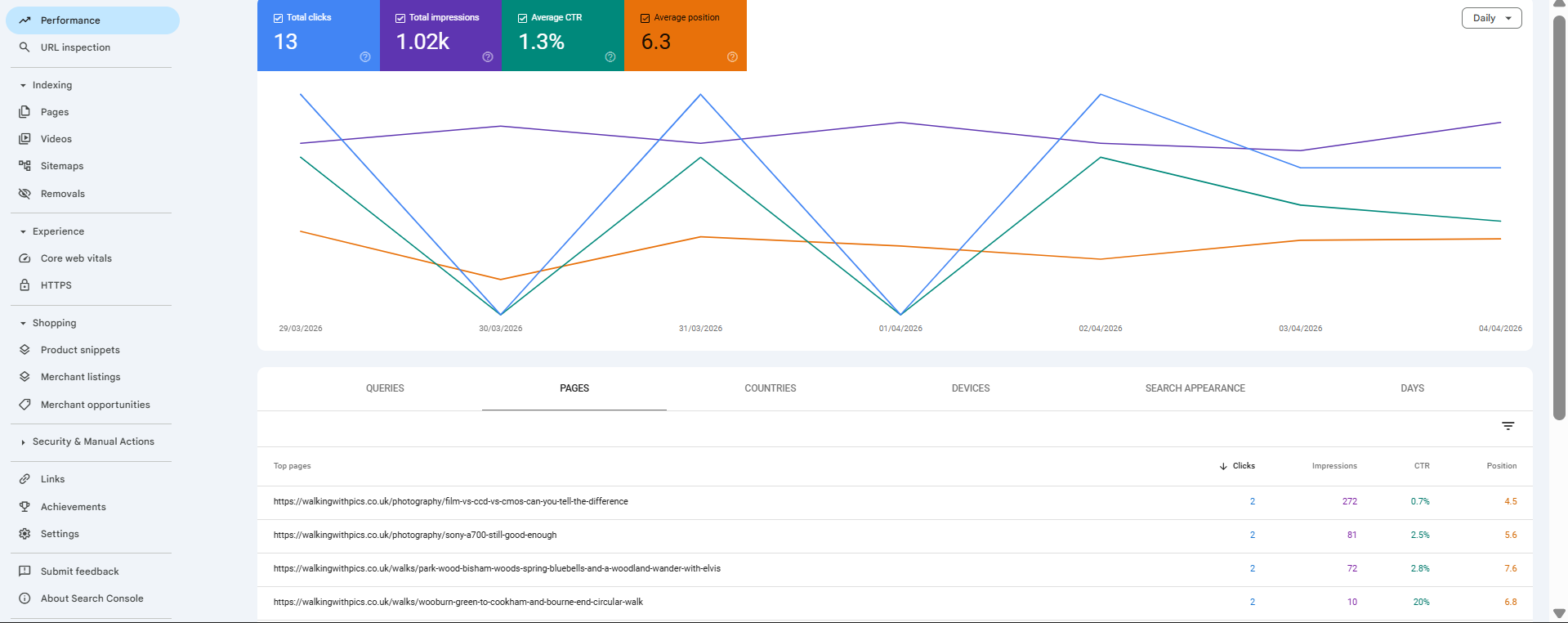
Example of Google Search Console.
For a new site, Search Console is the first place to look. Getting your pages indexed promptly matters, and the ability to manually request indexing for new content as soon as it goes live is one of the most useful habits you can build early on. Don't publish and wait. Submit it yourself and remove the uncertainty.
Google Analytics operates on a different level. Where Search Console tells you how people find you, Analytics tells you what they do once they arrive. How long they stay. Which pages they visit. Where they came from — whether that's organic search, a direct visit, a referral from another site, or somewhere else entirely. It shows you where people drop off, which content holds attention, and over time it builds a picture of how your audience behaves that you simply can't get any other way.
Together these two tools give you everything you need to make informed decisions about your content and your SEO. The problem is that neither of them is particularly intuitive when you first encounter them. The dashboards are dense, the terminology isn't always obvious, and it's easy to end up staring at a wall of data without knowing what any of it is actually telling you.
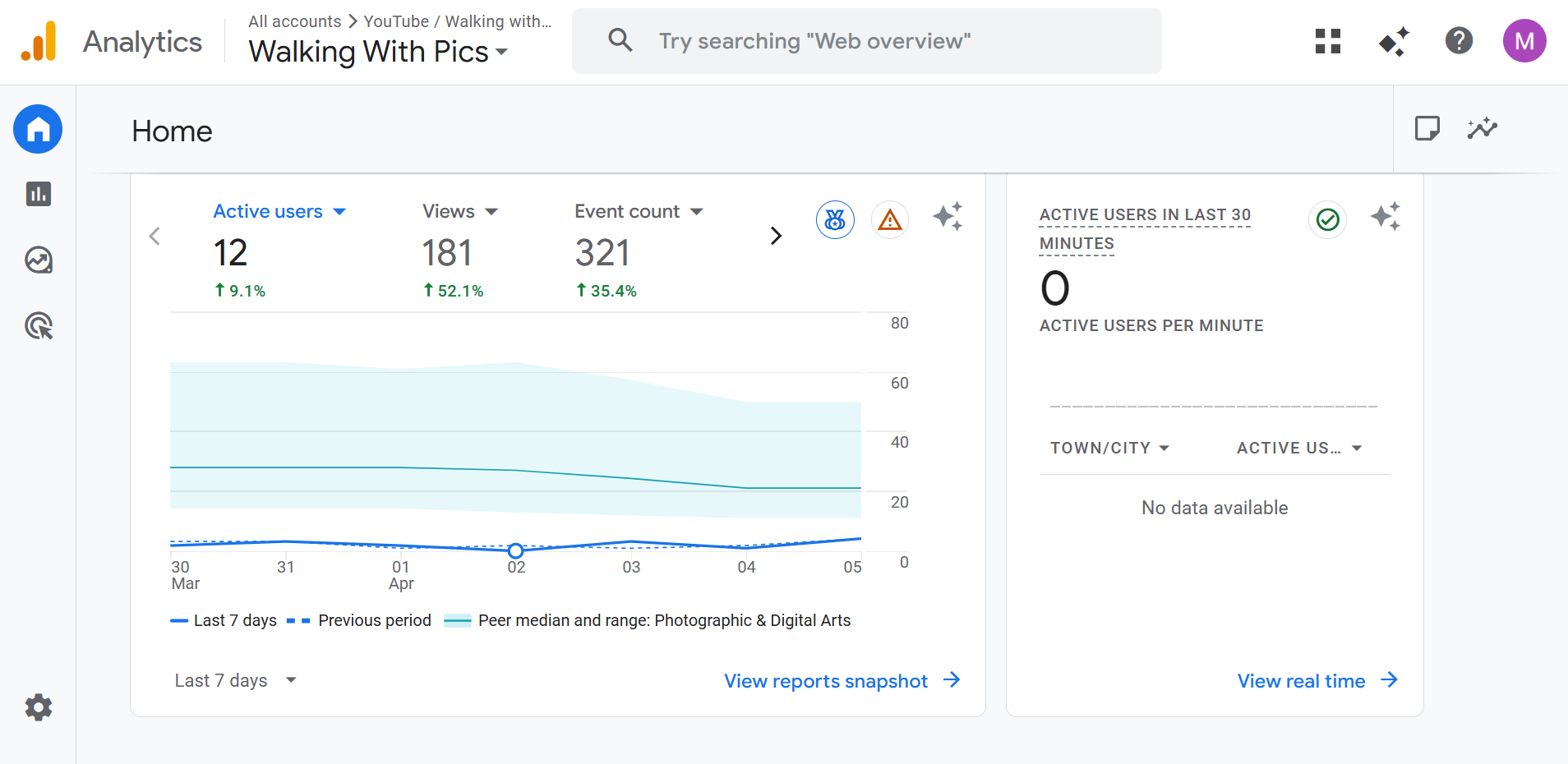
An example of Google Analytics website.
This is where AI earns its place as a genuinely practical tool rather than just a buzzword.
If you're looking at a Search Console report and can't make sense of why a page has high impressions but almost nobody is clicking it, ask an AI. Paste in the numbers, describe what you're seeing, and ask for a plain English explanation of what it means and what you should do about it. If your Analytics is showing a high bounce rate on a page you thought was strong, ask why that might be and what to look at. If your average position is improving but clicks aren't following, ask what the likely causes are.
AI tools are remarkably good at this kind of analytical conversation. They can break down what would otherwise take hours of reading documentation into a clear, specific explanation that relates directly to your situation. You don't need to become an SEO expert or a data analyst. You need to understand your own site well enough to make sensible decisions, and AI bridges that gap faster than anything else currently available.
The key is to treat it as a conversation rather than a search engine. Don't just ask "what is bounce rate." Ask "my walking photography blog has a 78% bounce rate on mobile but 45% on desktop — what are the most likely reasons and what should I check first." The more specific the question, the more useful the answer.
I’ve used Google Gemini for this example, other AI sources are available, personally I use Claude ai.
What you're aiming for over time is a feedback loop. You publish content, you monitor how it performs, you identify what's working and what isn't, and you adjust. It sounds straightforward and in principle it is — but only if you're actually looking at the data regularly and acting on what it tells you rather than publishing into the void and hoping for the best.
It's not glamorous work. It's nothing like standing in a Chiltern woodland at first light waiting for the mist to move. But it's the difference between a website that grows and one that doesn't.
The "Invisible Gallery" Problem
The single most common failure mode for photography websites is building what amounts to a digital shoebox. A collection of beautiful images with no context, no utility, no reason for a stranger to visit and no reason for Google to send them there.
A website that just shows photographs is only interesting to people who already know about you. It offers nothing to someone who found it through a search. There's no reason to return, no reason to share it, and no mechanism for turning a visitor into a customer. It screams "look at me" in a room where thousands of other people are shouting exactly the same thing.
The websites that work — the ones that build audiences and generate income over time — are the ones that offer something beyond the images themselves. Location guides. Honest equipment reviews. Practical advice. Behind the scenes insight into how the work is actually made. Content that answers questions people are actually asking. That's what drives organic traffic. That's what gives a visitor a reason to come back.
This is the shift that separates a portfolio from a business asset. It's not about having better photographs than everyone else. It's about being useful to the person reading.
Social Media: Worth It or Not?
I made a deliberate decision to build my site without any reliance on social media, so I'm going to be transparent about that context when I share this section.
Social media in 2026 has become an increasingly difficult environment for photographers. The major platforms have shifted heavily towards video content — if you're not producing Reels, short-form video, or similar content, your organic reach is minimal. That means photographers who built followings around still images are finding themselves in the position of having to become videographers just to stay visible.
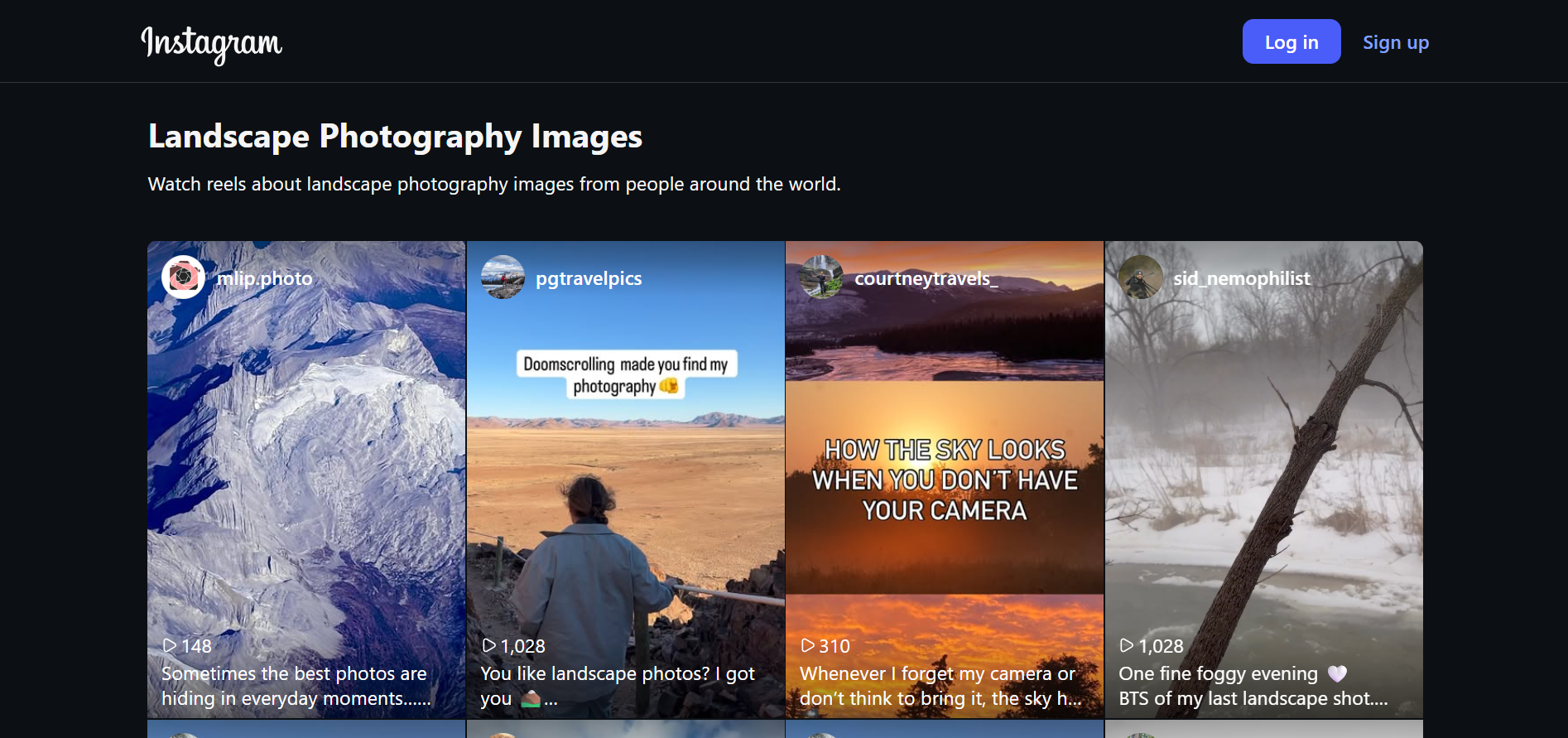
I searched Instagram for landscape photography images — it gave me reels. That tells you everything you need to know about where the platforms are heading.
The platforms themselves are rented space. You don't own your audience there. Algorithm changes can reduce your visibility overnight. Content gets compressed, viewed for three seconds, and scrolled past. It's not a natural environment for contemplative landscape photography.
That said, for photographers who are willing to put the work in, social media can drive traffic to a website in ways that take years to achieve through organic search alone. YouTube in particular is cited as one of the most effective tools for building genuine trust with an audience — people who watch behind-the-scenes content and tutorials develop a real connection with the work, which translates into website visits and purchases at a meaningful rate.
The honest position is this: social media helps, but only if you're using it intentionally as a funnel towards your website rather than treating it as the destination itself. Spending twenty hours a week on Instagram while putting one hour into your website is a reliable way to end up with a large social following and a pointless website.
I've chosen to do without it entirely and back myself to build something on organic search alone. It's a slower road. Whether it pays off is part of the five year plan.
So Is It Worth It?
That depends entirely on what you want from it and whether you're honest with yourself about what you're committing to.
If you want a place to share your work, keep a record of your photography, and connect with people who share your interests — yes, a website is worth it. The bar for that kind of site is lower and the satisfaction is genuine.
If you want to build something that generates some kind of income over time — that's a different conversation. It's achievable. People do it. But it requires a long-term commitment to content, SEO, AEO, consistency, and the unglamorous administrative work that nobody mentions in a sponsored video. It requires going in knowing that the first year will probably feel like shouting into a void. It requires a plan, not just a passion.
AI image help at its best: Mock up of Elvis, helping with the website so he can get out for a walk quicker !!
The websites that succeed are the ones built by people who stopped thinking of themselves as photographers with a website and started thinking of themselves as publishers who also happen to be photographers. The photographs matter. But the content around them, the utility offered to visitors, and the patience to see a five year plan through — those things matter more.
I'm four months in. The early evidence so far suggests my own approach is working. Ask me again in 2029.
So if this hasn’t put you off and you decide to create your own space on the internet - I wish you all the best.