Woodland Photography in the Chiltern Hills — Part 2
If Part 1 was about the quieter, more intimate woodlands — the kind you can walk through in an hour and feel like you have the place to yourself — Part 2 is about scale. Penn Wood and Burnham Beeches are both serious woodlands. The kind that take multiple visits before you start to understand them, and where every season genuinely changes the experience rather than just the temperature.
There's a difference between knowing a wood and understanding it. Knowing it means you can find your way around without a map and you know roughly where the best trees are. Understanding it means you know how the light moves through it at different times of year, where the mist settles on a cold morning, which sections flood in winter and open up new reflections, and which paths to avoid on a Sunday afternoon if you want any chance of a clean composition without a Labrador in the foreground. That kind of understanding takes time. Years, not visits. I've been coming to both of these woodlands regularly since moving to the area and I'd hesitate to say I fully understand either of them. That's not frustrating. That's the point. A wood that gives you everything on the first visit may not encourage you enough to keep going back.
Penn Wood and Burnham Beeches both give you plenty of reasons to go back.
Penn Wood, Penn Street
Penn Wood is another woodland within easy reach of my front door. It sits near Penn Street in the heart of the Buckinghamshire Chilterns, and at roughly 176 hectares it's one of the largest ancient woodlands in the region. It's managed by the Woodland Trust now, but it came closer to not existing as a public woodland than most people realise. In 1990 the wood was sold to a private developer and plans were drawn up to convert it into a commercial golf course. Before planning permission was even officially rejected, some trees had already been bulldozed. A determined local campaign — led largely by the Friends of Penn Wood — fought the proposal for years, and in December 1998 the then Deputy Prime Minister John Prescott finally rejected the application. The Woodland Trust bought the site the following year for £1.2 million. Standing among the veteran trees on a quiet morning it's difficult to imagine what was nearly lost, but it was a closer call than it should have been, and the fact that someone had already started cutting trees down before the decision was made tells you everything you need to know about how these things can go.
The history of Penn Wood runs deep. During the Second World War it was converted into a substantial army training camp — assault course, rifle range, the lot — and later served as a reception centre for Polish soldiers who couldn't return home after the war, much like Hodgemoor. Walk off the main tracks today and you'll find concrete pads where huts once stood, earthworks from the training grounds, and brick fragments under the leaf litter. The wood absorbs history quietly. It doesn't announce it.
Historically, Penn Wood was also central to the High Wycombe chair industry. Local craftsmen known as bodgers lived and worked within the wood itself, turning beech on pole lathes to produce chair legs. The beech trees that made the Chilterns famous for furniture are the same trees you're photographing today. That continuity is worth thinking about when you're trying to decide what it is you're actually pointing your camera at.
For photography, Penn Wood rewards patience and exploration. The main ride through the centre is wide and easy to follow, but it's the smaller paths branching off it where the more atmospheric ancient sections reveal themselves. The veteran trees here have character — gnarled, wide-trunked, with the kind of presence that makes you want to work around them for longer than is probably sensible. And you will. And something will still be cluttering the frame.
The wood-pasture character of Penn Wood means the planting mix is more varied than a standard beech woodland, and that variety shows itself across the seasons. In spring you get the usual Chilterns bluebell carpets under the beech and oak canopies, but look closer to the ground and you'll find wood anemones, yellow archangel, lesser celandine, and wood sorrel appearing before the canopy closes over. These are ancient woodland indicator species — plants that only establish themselves in ground that has been continuously wooded for centuries. They don't move fast. Finding them tells you something about the age of the place you're standing in. For close-up work they're worth the time — low-growing, delicate, and easy to lose against the leaf litter if you're not paying attention.
Later in the year the open sections and rides fill with foxgloves, heath bedstraw, and gorse, and the cattle grazing keeps those areas open enough for light to reach the ground in ways it can't in the denser woodland. Then autumn arrives and Penn Wood becomes something else entirely. It's a major site for the Bucks Fungus Group and hundreds of species have been recorded here. The Fly Agaric near the birch trees is the obvious one — the classic red and white fairytale toadstool that photographs exactly as well as you'd expect. But dig a little deeper and you'll find the Amethyst Deceiver, a small deep-purple mushroom that sits beautifully against brown leaf litter, the Beefsteak Fungus on the ancient oaks, and the Saffrondrop Bonnet — a delicate tall-stemmed mushroom that bleeds bright orange if the stem is broken, which is the kind of detail that makes for a good macro sequence if you're willing to get properly low and muddy. For black and white photography, the Warlock's Butter — a black jelly fungus on fallen beech — gives you textures that are genuinely hard to find anywhere else.
The Holey Oak is worth finding — a massive, hollowed-out ancient oak that's been pulling in photographers and curious children for years. It's the kind of subject that risks looking like every other Holey Oak photograph ever taken, so the challenge is finding your own angle on it rather than the obvious one. That's true of most iconic woodland features.
One practical note: the Woodland Trust also grazes a small herd of cattle in parts of the wood as part of a wood pasture management programme, mimicking centuries of traditional land use. If you encounter them, give them space.
The best access point is from the Penn Street side — park near the church, there's a little lane off the road with a reasonable size car park or alternatively the Hit or Miss pub, which handily provides a post-walk reason to linger. The pub part is optional. The walk is not.
Burnham Beeches
Burnham Beeches is in a category of its own. At 220 hectares it's the largest of the woodlands I visit regularly, and it has the kind of reputation that precedes it — owned by the City of London Corporation since 1880, triple-designated as an SSSI, a National Nature Reserve, and a Special Area of Conservation, and famous enough to have stood in for the Forbidden Forest in Harry Potter and Sherwood Forest in Robin Hood: Prince of Thieves. That level of fame brings people, and managing your expectations around footfall is part of visiting Burnham Beeches, particularly on weekends.
Go early. It's worth saying twice. Go early.
The ancient pollarded beeches and oaks are the reason people come, and they are extraordinary. Pollarding — cutting the upper branches above grazing height to encourage regrowth — was practised here for centuries, and the result is trees with massive, squat trunks and enormous branching crowns that look unlike anything in a conventionally managed wood. Many are 400 to 500 years old. The Druid's Oak is estimated at over 800 years. When pollarding stopped in the 1800s the heavy branches began splitting the old trunks, and the City of London Corporation now has specialist arborists working to restart the cycle on younger trees, ensuring the next 500 years of the wood look something like the last 500. That's a long view that's hard to argue with.
For photography, these trees are both the reward and the problem. They are extraordinary subjects. They are also surrounded by other trees, undergrowth, and in summer a dense canopy that eliminates most of the light you need. The cluttered composition issue that affects all woodland photography is amplified here by the sheer density of the place. You will circle the same pollard three times and still not find the clean angle you're looking for. That's Burnham Beeches. Accept it early and you'll have a better time.
The best conditions are mist or soft overcast light, particularly in autumn when the beech colour is at its peak and the fungi are appearing on every fallen trunk. The wood is one of the most important fungal sites in the UK — over 800 species recorded — and in autumn the bracket fungi on the ancient beeches and the smaller species threading through the leaf litter are worth as much of your time as the trees themselves.
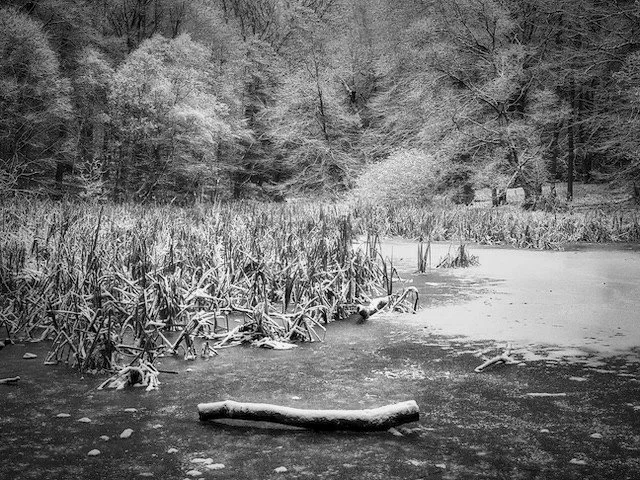
The two ponds — Upper and Lower — were originally medieval fish ponds and are now one of the best sites in the country for Mandarin ducks. The males in full plumage between October and May are genuinely spectacular, though they're shy and early morning at the Upper Pond is your best chance of finding them on open water before the paths fill up.

Walk along Lord Mayor's Drive and look closely at the path surface. Much of the rubble laid down to support 100,000 military vehicles during the D-Day build-up in 1944 is still there underfoot — red brick and masonry salvaged from London buildings destroyed in the Blitz. Some of the trees along the route still have telephone insulators attached high on their trunks, remnants of the army's communication lines. History again, absorbed quietly into the landscape.
One practical note before you visit if you own a dog, and it's worth paying attention to. Burnham Beeches operates a zoned dog control system under a Public Spaces Protection Order, and it's enforced. The wood is divided into areas where dogs must be on a lead at all times, areas where they can be off-lead under effective control, and a small exclusion zone around the café where dogs aren't permitted at all. The on-lead zones cover the most ecologically sensitive areas — the ancient pollards, the Upper and Lower Ponds, and the main central routes including Lord Mayor's Drive. If you're caught with a dog off-lead in a restricted area the rangers will issue a fixed penalty notice on the spot — £100. Ignore that and it can end up in court. The City of London Corporation employs constables and rangers who patrol regularly and they take it seriously. Elvis stays on the lead for most of Burnham Beeches. That's fine. He's learned to cope with it. Before you visit, it's worth downloading the official dog walking and PSPO map from the City of London Corporation website — it clearly shows the on-lead, off-lead, and exclusion zones across the whole site: Burnham Beeches Dog Walking Map
Cattle and horses also graze parts of the wood at certain times of year as part of the ongoing land management programme. There's generally signage where this is the case, but it's worth being aware of before you arrive, particularly if you're bringing a dog. A wood pasture without grazing animals isn't a wood pasture — the grazing is what keeps the open sections open and the ecosystem functioning — but it does require a bit more awareness from visitors than a standard woodland walk.
The main car park is well signposted off the A355. There's a café and toilets at the visitor centre for when you've had enough of the cold. The wood is big enough that if you push beyond the obvious central paths and the areas nearest the car park, it opens up considerably. The edges and quieter corners are where Burnham Beeches becomes something other than a busy recreational site and starts feeling like the ancient landscape it actually is.
Part 3 covers Ashridge Estate and the Bisham Woods complex — incorporating Park Wood and Quarry Wood — two very different woodlands that together make a compelling case for why the Chilterns remains one of the finest landscapes in England for anyone who wants to spend serious time among trees.