Woodland Photography in the Chiltern Hills — Part 1
There are apparently over a thousand named woodlands in the Chiltern Hills. A thousand !! They cover roughly 21% of the landscape — around 17,500 hectares — making the Chilterns one of the most heavily wooded areas in the whole of England. I've lived within easy reach of them for seven years or more now, and I've barely scratched the surface. Some are private. Some are barely more than a copse between two fields. But many are ancient, extraordinary, and completely free to walk into on any given day with a camera and a dog.
I'm never going to get round all of them. That's fine. The ones I keep returning to are more than enough.
Woodland photography is a strange pursuit. It can give you calmness and frustration in the same breath, sometimes within the same ten minutes. You find a tree — genuinely extraordinary, the kind of thing that stops you mid-stride — and then you spend the next half hour circling it. Move left. Move right. Crouch down. Stretch up. And still, whatever's around it just won't cooperate. A branch cutting across exactly the wrong place. Holly pushing in from the left. A cluster of dead bracken that draws the eye to entirely the wrong part of the frame. No matter how good your subject is, it's often what surrounds it that stops the shot from happening.
Woodland photographers talk a lot about chaotic compositions. I prefer the word cluttered. Because that's what it is. The woodland doesn't arrange itself for you. It never has and it never will. That's part of the deal.
One thing worth mentioning before we get into the woods themselves — please stick to the pathways. Particularly during bluebell season. I was at Church Wood once and got talking to a local lady from the village who was visibly frustrated about people trampling the flowers to get a better angle. I understood her frustration completely. The bluebells are there for everyone to experience and enjoy, not just photographers, and no shot is worth destroying what you came to photograph in the first place. If the composition doesn't work from the path, it doesn't work. Move on.
Despite all of that — or maybe because of it — these places keep pulling me back.
Church Wood, Hedgerley
A quick note before we get into Church Wood specifically. Every photograph on this site is black and white. That's not going to change. But there are subjects that exist almost entirely because of their colour, and bluebells are one of them. Converting a bluebell wood to black and white doesn't give you a moody woodland floor — it gives you a patch of indistinct ground cover with some trees in it. The colour is the point. Knowing the limitations of your chosen approach is as important as knowing its strengths, so the images accompanying this section are in colour. It won't happen often. It might not happen again. But bluebells are bluebells.
Church Wood Reserve sits near the village of Hedgerley in South Buckinghamshire, managed by the RSPB, and officially part of the Chilterns National Landscape. There's no car park at the reserve itself — you park on the roads around the village pond near The White Horse pub and walk down the track from there. Through a kissing gate and you're into the meadow, which slopes upward through the wildflowers before you reach the tree line of the wood proper. That transition — bright open meadow in the foreground, dark beech and oak canopy rising behind it — is one of the better compositional opportunities the reserve offers, and it's right there at the entrance before you've even got into the trees.
The RSPB mows the meadow once a year in late summer and leaves the clippings in piles, which sounds untidy until you realise those piles are basking and breeding habitat for grass snakes, slow worms, and a significant range of insects. From June to August the meadow fills with Marbled Whites, Peacocks, and Red Admirals. It's not the wood that's doing the work at that time of year — it's the meadow.
The wood itself is a classic Chilterns mix of beech, oak, and ash, and the RSPB's approach here is minimal intervention — they leave as much deadwood standing and fallen as possible. For photography that means moss-covered fallen trees, bracket fungi on rotting trunks, and in autumn a serious showing of Jelly Ear on the elder and small Mycena bonnets threading through the leaf litter. It's good macro photography territory if that's your thing. In black and white, the textures on those fallen giants can be extraordinary.
Spring is the obvious draw — the bluebell season here is genuinely special, and the wildflower meadow adds a second act that a lot of purely woodland sites can't offer. But the structure of the place in winter, when the canopy is stripped back, shows you things that the summer hides. I'd argue it's worth a visit in every season before you think you know it.
Elvis reviews it favourably year-round. That's good enough for me.
Parking: Village roads near the pond, Hedgerley. Postcode SL2 3XB. Walk down the farm track to the right of the pond, meadow entrance on the left through a kissing gate.
Hodgemoor Wood, Chalfont St Giles
Hodgemoor Wood sits between Chalfont St Giles and Seer Green. It covers 100 hectares of ancient semi-natural woodland — beech, oak, hornbeam — managed by Forestry England as a designated Site of Special Scientific Interest. It's one of the best bluebell sites in the country. The Times once named it the number one place in the UK to see them. That's not a claim I'd have predicted, and if you've visited and come away thinking there weren't many bluebells, there's a reason for that — the best displays are tucked deep into the ancient core of the wood, well off the main bridleways. Stick to the wide horse trails and you'll see thin patches. Head onto the smaller, quieter footpaths and you'll find the violet mist that earned that Times headline.
Timing matters too. The soil at Hodgemoor is varied — clay, sand, gravel — and the bluebells thrive in specific pockets of ancient loamy ground rather than across the whole wood evenly. Visit slightly late in May and the bracken and ferns can overtop the flowers entirely, making it look like there's nothing there when the display beneath is actually at its peak. You have to catch it right. That's the deal with bluebell photography anywhere, but Hodgemoor is less forgiving than most.
One thing that makes Hodgemoor genuinely distinct for photography is the combination of bluebells and wild garlic growing in the same sections. The white stars of the garlic against the blue of the bells is worth getting low for — the contrast in colour and texture on the woodland floor is one of those compositions that rewards close work. And the scent of wild garlic on a warm spring morning in these woods is something you don't forget. It's that kind of sensory detail that puts people in a place before they've visited.
It's also popular with horse riders. The Hodgemoor Riding Association maintains around 5km of dedicated trails and the equestrian presence is noticeable. Elvis goes on the long lead here. He's not aggressive, but a thousand kilograms of horse doesn't need an enthusiastic large white goldendoodle appearing from nowhere, and neither does the rider.
What I find most interesting about Hodgemoor for photography is its history, which is written into the ground itself if you know what you're looking for. During the Second World War the wood was used as a military base, hidden from aerial view by the dense canopy. After 1945, the huts were converted into a displaced persons camp for Polish families who couldn't return home under Soviet occupation. At its peak, roughly 500 to 600 people lived here — families, in a wood in Buckinghamshire, with their own school, chapel, shop, and post office. The camp didn't close until 1962.
Walk through Hodgemoor today and you'll find concrete foundations, drainage gulleys, brick fragments under the leaf litter. Easy to miss if you're not paying attention. Worth knowing about if you are.
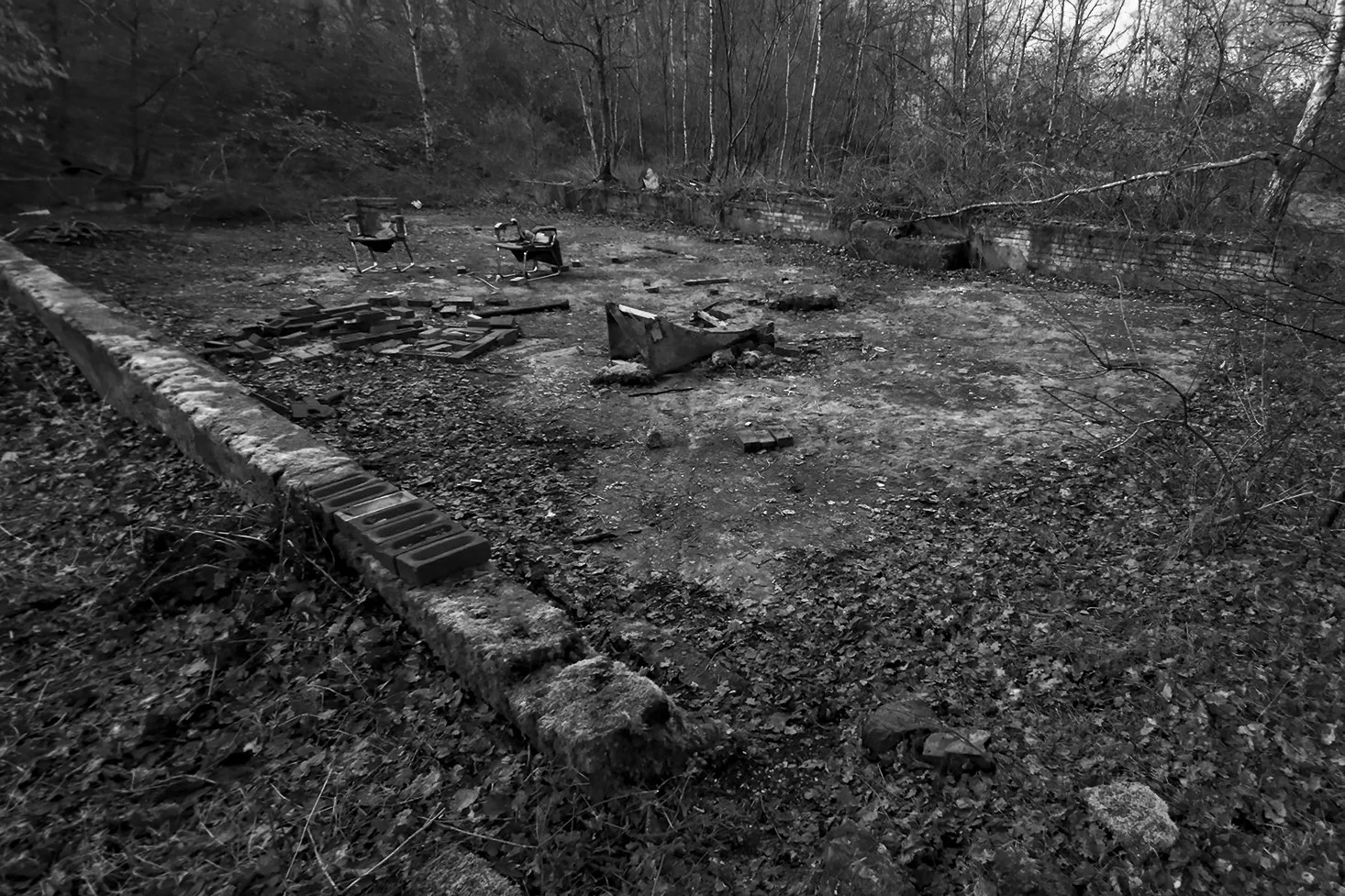
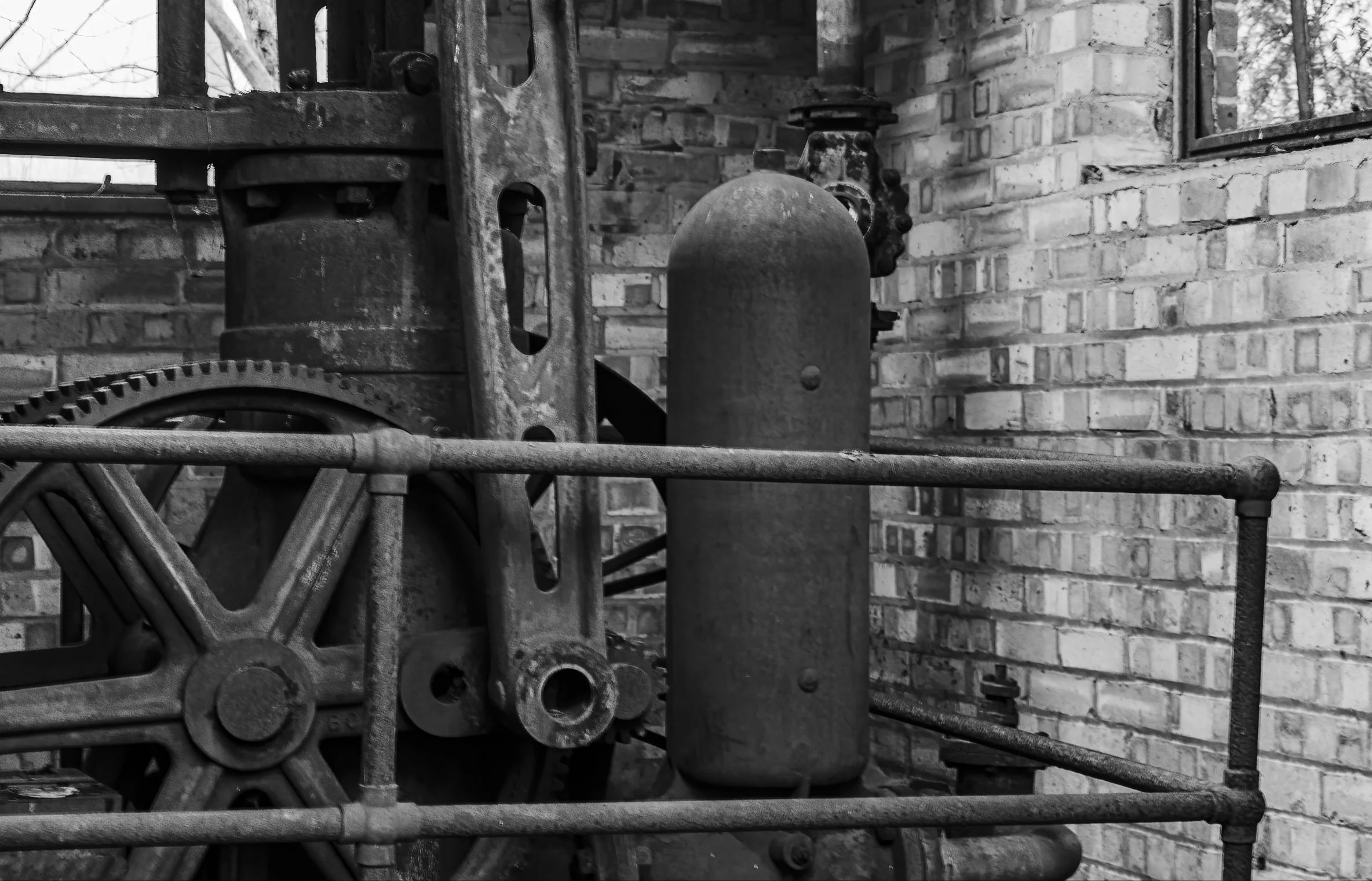
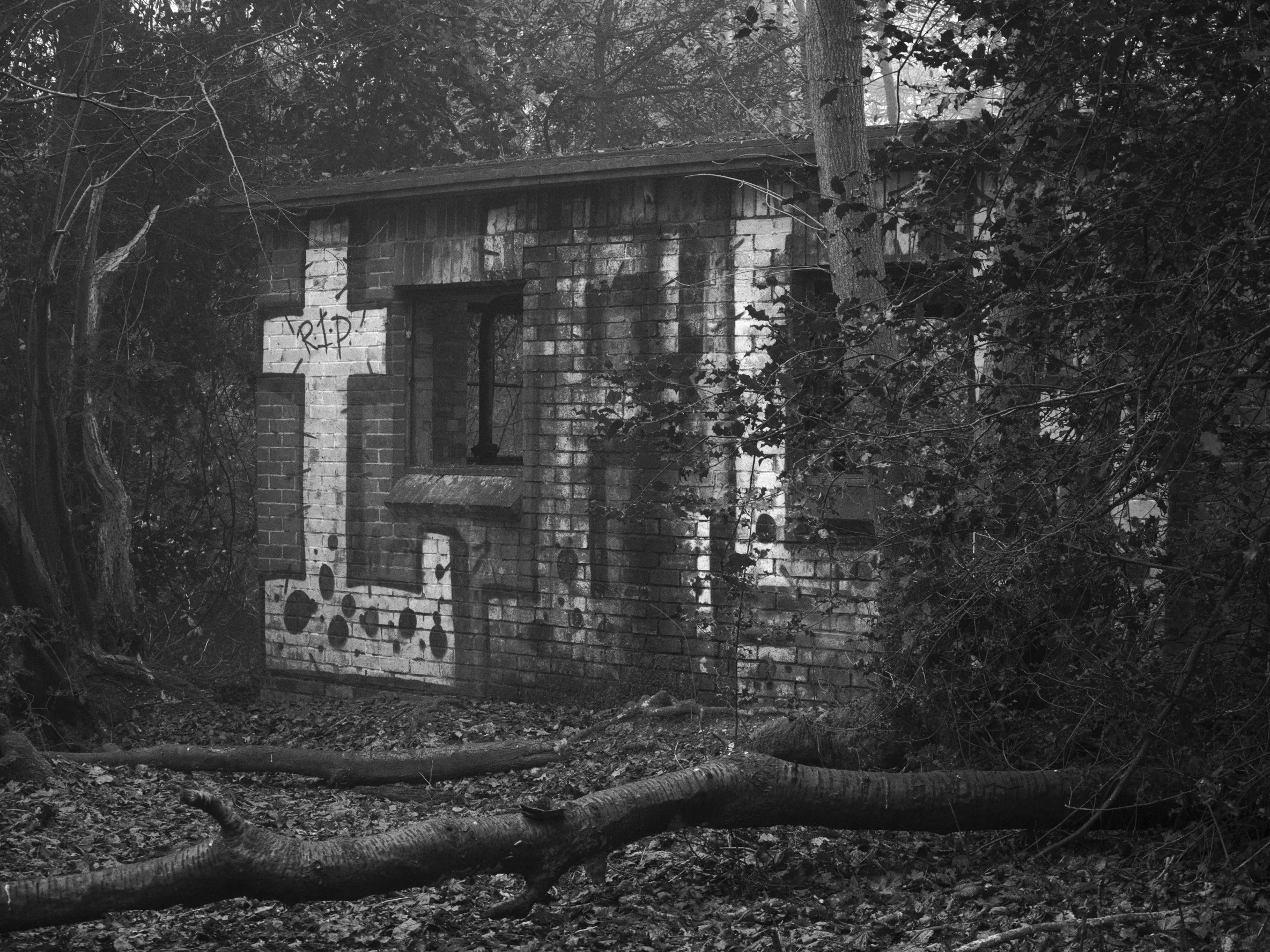
For woodland photography, this history gives the place a weight that's hard to explain but easy to feel. The trees are the same trees that provided cover for both an army and a community. That does something to how you look at a wood.
Compositionally, Hodgemoor can be as cluttered as anywhere else. The holly understorey in sections is dense and uncooperative. But push further in, away from the main paths, and it opens up into something quieter and more atmospheric. That's usually where the better photographs happen — not at the obvious points, but wherever you end up after ignoring the obvious points.
My second visit to Hodgemoor is probably one of the most memorable mornings I've had in any woodland. I arrived early, and the mist lay almost throughout the entire wood — not patches of it, but a continuous low blanket threading between the trees. When the sun finally broke through the clouds it lit the whole wood in an orange glow that I wasn't prepared for. The mosses on the fallen trees — bright green against that warm light — were almost luminous. Surreal is the right word for it. I've been back to Hodgemoor many times since and I've never seen it like that again. You show up, and occasionally it does something extraordinary. All you can do is make sure you're there when it does.
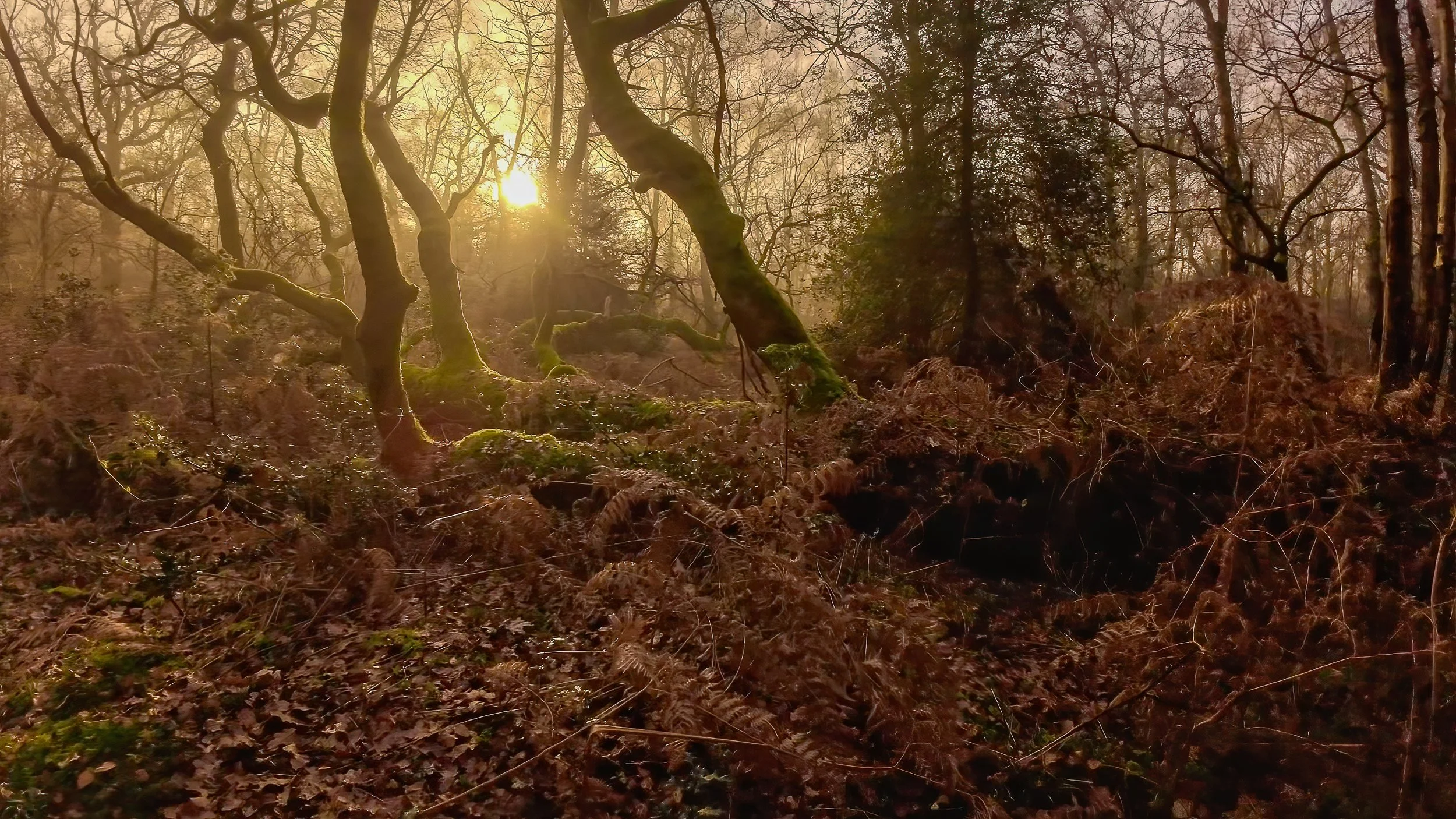
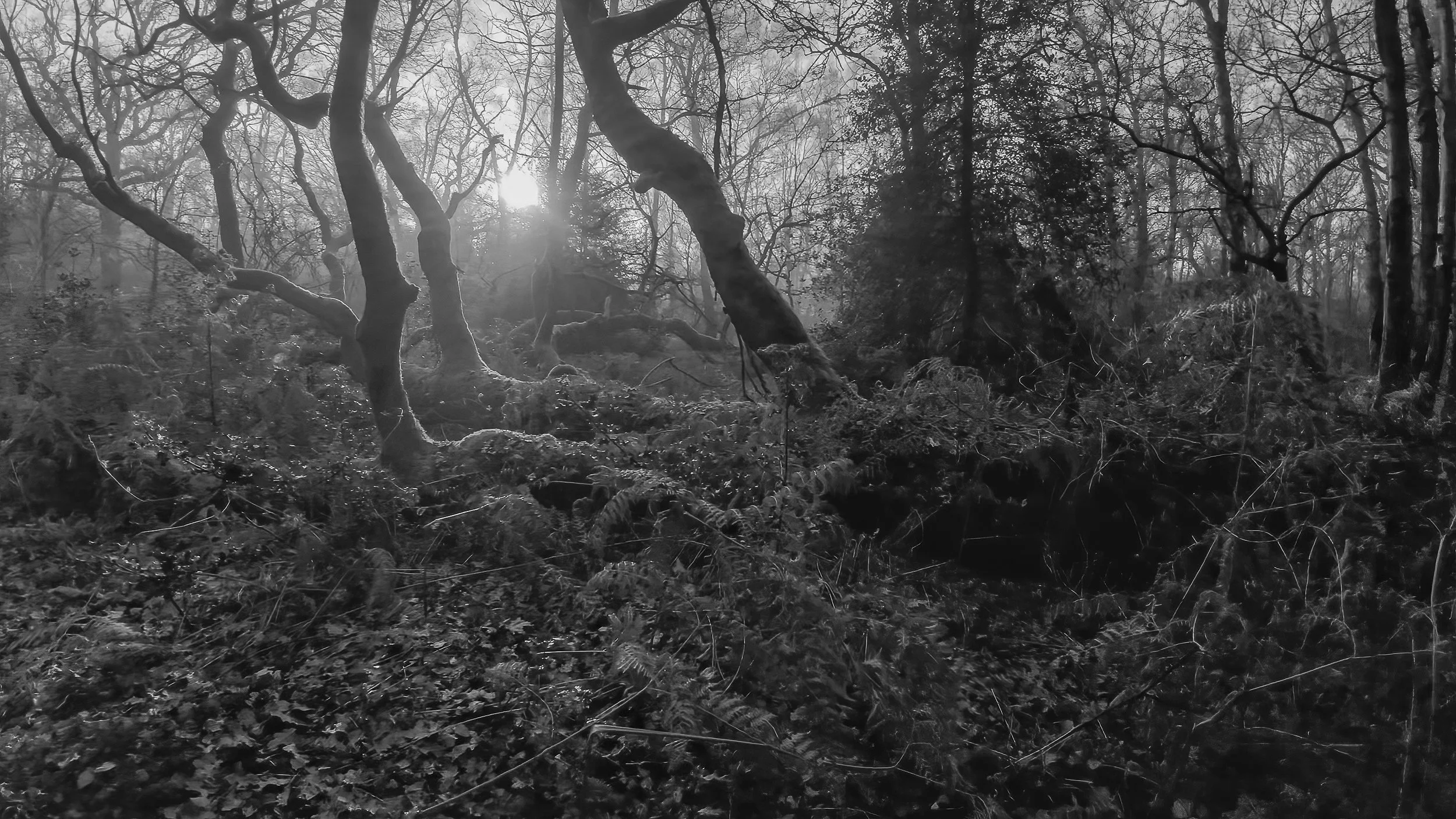
Above: This image was taken way before I made the decision to shoot exclusively in black and white. The colour version was never intended to be converted — and as you can see, it shows. A colour image forced into black and white loses the very thing that made it worth taking in the first place. It's exactly why shooting with intention matters.
That's the thing about woodland photography. You never really finish learning a wood. You just get better at listening to it.
Part 2 covers two of the heavyweights — Penn Wood and Burnham Beeches. Between them they account for some of the oldest, most significant ancient woodland in the south of England, and each one presents its own particular set of rewards and frustrations for the photographer. Part 2 coming soon.