Wooburn Green to Cookham and Bourne End Circular Walk
It’s Boxing Day, and it’s going to be a busy one. The family are coming over for a late afternoon lunch. I’ve done the mental arithmetic, worked out the timings — there’s enough of a window for Elvis and me to get a morning walk in and still be back in time to help get things ready. Nothing fancy, just one of our familiar routes from the doorstep.
I slip into my walking gear and grab the camera bag. Elvis isn’t daft — he knows the difference between a work bag and a camera bag. He’s already by the door, stretching long and slow, tail wagging. Excited. He knows we’re going out. His pre-walk routine is a little too eager. I haven’t even had my morning coffee yet.
The forecast looks good. Cloudy with sunny spells — ideal for the moodier photographs I’m drawn to. There’s a slight chill in the air, though not as sharp as the previous mornings. Perfect walking weather. No danger of getting too warm.
With all that in place, the walk itself feels familiar before we’ve even set off. Some walks feel like routines, and others feel like journeys. This loop from Wooburn Green through Hedsor, over to Cookham and back via Bourne End sits somewhere in the middle — familiar enough to feel welcoming, yet varied enough to keep surprising you each time you set out. It’s a route that mixes village life, old woodland, sweeping river views and a few unexpected discoveries along the way. Starting and finishing at Wooburn Park, the loop ties together several distinct landscapes, threading them into a walk that feels both coherent and quietly rewarding
Stepping out from the front door, the walk begins almost before it registers as one. Wooburn Park is only five minutes away on foot, so we walk rather than drive. For visitors, though, the car park there makes a natural start and finish point — easy, practical, and well placed for the loop ahead.
We head down Wooburn Town Road, passing behind the church where a short row of old cottages sits quietly alongside the road. Cobbled paths run across their fronts, worn and uneven, the kind of detail that always catches my eye. They would make a lovely photograph if left to themselves. Unfortunately, they rarely are.The foreground is cluttered with parked cars, so the composition never quite has room to breathe.
Still, the camera comes out of the bag. You work with what’s in front of you, not what you wish was there. I frame it as best I can, knowing it isn’t the image I’m after — not yet — but it’s good enough for a warm-up. A way of shifting the mind into photographic mode. The shutter clicks. A shot in the bag. One day, I’ll get the version of that scene I’m still waiting for.
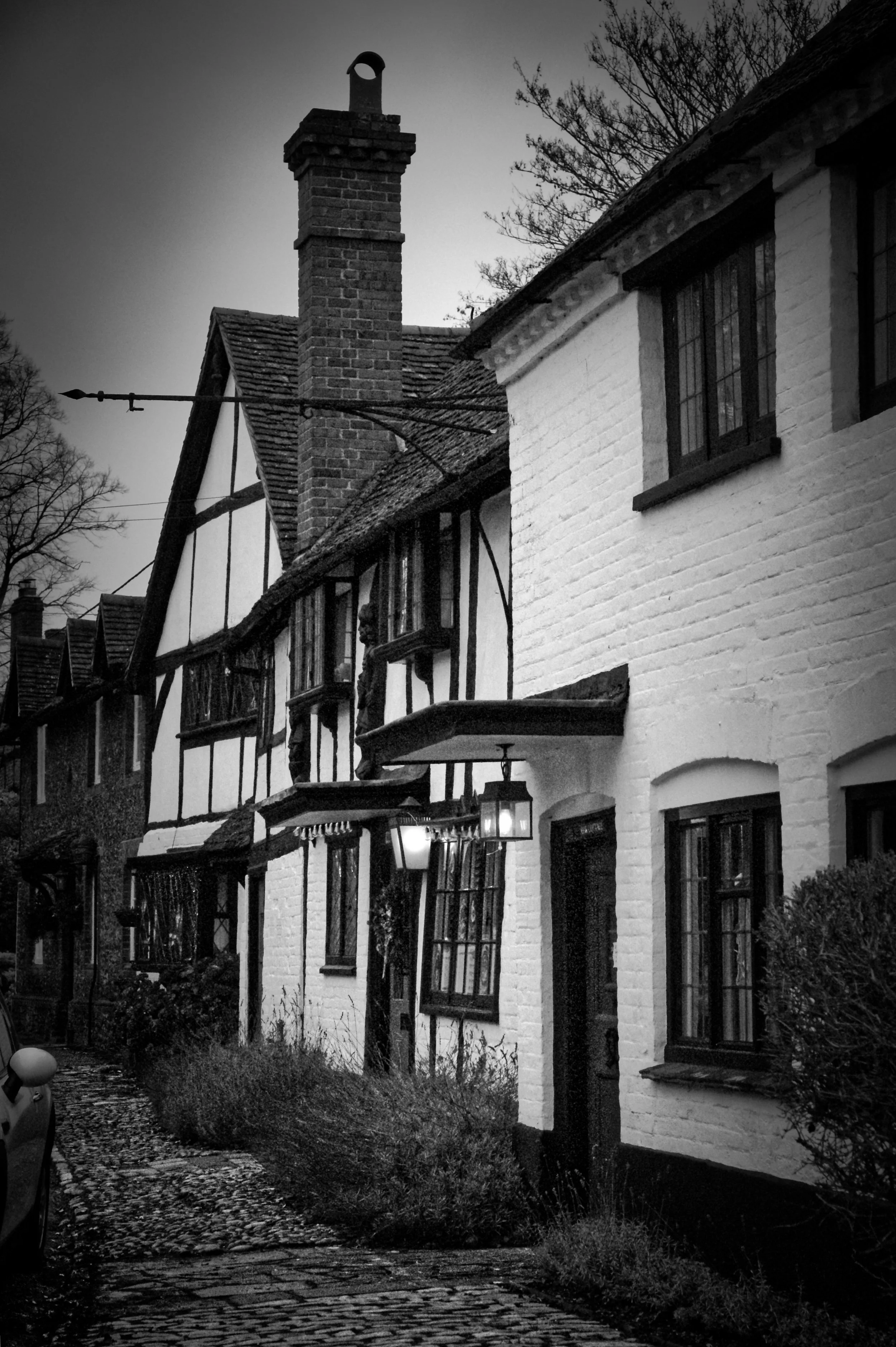
A quick frame on Wooburn Town Road — working with what’s there.
There’s a relaxed feel to the area, villagers out early with their dogs. It’s quieter today — on a normal day, you’d expect families in the playground and people heading for the tennis courts. Walking away from the park and turning onto Wash Hill Road gives the first sense of leaving the village behind. It’s a gentle climb, just enough to warm the legs without any real effort. The road bends slightly as it rises. The real shift happens when you come off Wash Hill Road and onto the public footpath that cuts through the fields.
Almost immediately, the village begins to fall away behind us. The road gives way to a footpath and the land opens out as we start the steady climb through the field above Wash Hill. It’s instinctive to turn and look back. The light has settled on the church down in Wooburn Green, lifting it just enough from the surrounding rooftops to hold your attention for a moment.
The Sony A350 comes out of the hip bag. I raise it to my eye, take a moment to compose, check the exposure. It looks right. The shutter clicks. The second image of the walk is captured.
We carry on upwards, following the line of the path towards the kissing gate and the small woodland beyond. Elvis pauses for a thorough sniff — to investigate something of great importance, to him at least — before we move on again.
Inside Swiley Wood the light softens, filtered through bare branches, the ground darker and damp underfoot. A squirrel darts across the path and Elvis stiffens instantly, senses sharpened. It’s a good job he’s on the lead. He has strong opinions about squirrels.
The path slips us back out into the open, crossing the field before delivering us neatly onto Kiln Lane by the Chequers Inn. The pub itself sits quietly enough, but it’s the old AA sign fixed to the post outside that catches my attention. The kind you don’t see much anymore. I linger, trying a couple of compositions, narrowing the frame, shifting position slightly. So focused on what I’m trying to exclude that I don’t notice a family waiting to pass. When I do, I step aside, offer an apology, exchange a few polite words, and let them through. The moment passes. The camera goes back in the bag.
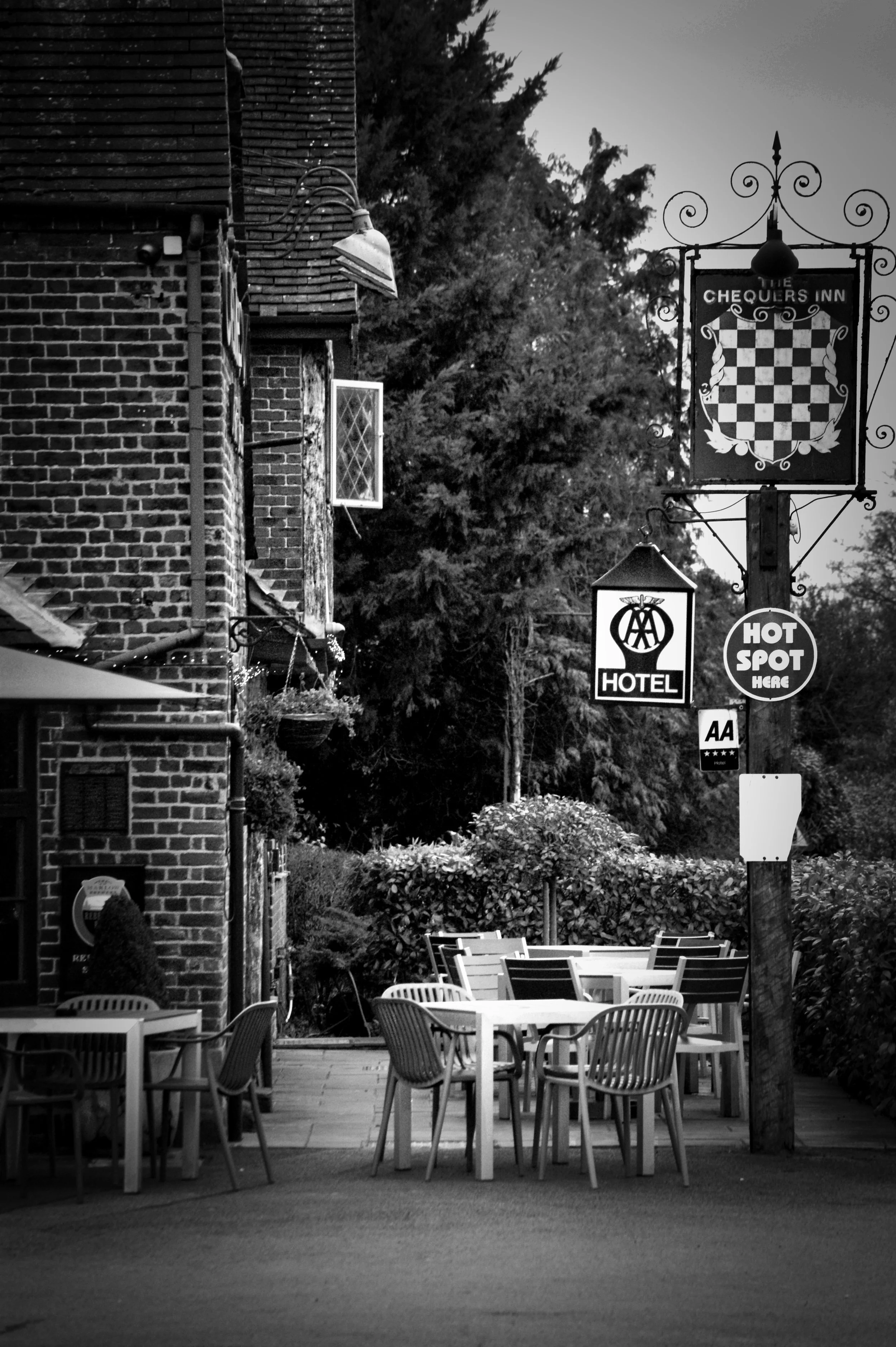
Turning right onto Harvest Hill, we walk through the houses that make up the Hamlet of Widmoor. From there, the route flows naturally left onto Broad Lane — a stretch that feels like a boundary line, not quite woodland, not quite village, sitting somewhere in between.
Broad Lane leads into Woolman’s Wood on the right. After a short distance the path forks, and we take the right-hand option: Church Path. The name suggests something obvious, but the church keeps itself hidden for a while. The path stretches on, long and enclosed, bordered by a mix of fencing, its destination unclear. It’s one of those sections that rewards patience — nothing to see yet, but a sense that something is coming.
Then, almost without warning, you step out onto a narrow single-track lane.
Only when you stop and glance uphill to the left does the surprise reveal itself: the small church of St Nicholas, perched quietly above the road. It’s modest, weathered, and full of character — the kind of place that feels like a reward for trusting the path to lead somewhere worth reaching.
A short walk along the lane brings us to a public footpath on the left, marked by a set of old steps, a church notice board, and a dilapidated kissing gate. It’s an easy invitation to follow. The climb through the field is brief but satisfying, and reaching the churchyard opens out views across the surrounding landscape.
Looking across to the next hill, a castle-like silhouette rises above the trees. This is Lord Boston’s Folly — also known as Hedsor Folly — sitting within the Hedsor House estate. Built in the late 18th century as a ‘sham’ castle, the flint and brick structure was designed to add a touch of romantic drama to the Buckinghamshire skyline. Whether intended to mark a royal recovery or a military victory, it now stands quietly on the hillside, an unexpected presence on a slow walk — a reminder that the landscape is as much social history as scenery.
Dropping back down to the lane and turning left takes us towards the end of the road, where the walk shifts again. We come out onto Hedsor Hill Road, cross straight over, and step into the Hedsor Priory Lodge Estate. You are very clearly entering somewhere private here — the gates make that much obvious — even though a public right of way threads its way through it. The route is there, but discreetly marked and easy to miss. Once inside, the atmosphere changes quickly. Gated drives, immaculate grounds, and large houses give the estate a quiet, self-contained feel. Following the road as it curves to the right feels like moving through a world deliberately set apart from everyday life.
The road eventually leads to a field, where the path continues through a gate on the left. The footpath follows the line of neatly kept hedges and crosses a small wooden bridge. Before committing to the route ahead, it’s worth taking a brief wander to the right and then turning back to look up the hill. From here, partially framed by trees, the rear of Hedsor House reveals itself — large, pale, and unmistakably grand. It’s one of those buildings that seems to sit just beyond reach, impressive without needing to announce itself. Known to many as a filming location for Downton Abbey, it’s a familiar sight in a very unfamiliar setting.
The Sony A350 comes out again, the recently acquired 55–200mm lens still attached from the folly earlier on. I take a quick reference shot rather than trying to force anything more — this is a scene that deserves a return visit. Ideally before winter gives way to spring, when the leaves will begin to close the view down again.
A horse in the nearby field has taken an interest, wandering back and forth along the fence line as if fully aware a camera is in play. It would be rude to ignore the opportunity, so I oblige with a few quick frames before moving back onto the main path.
From here, the walk settles once more. Turning left, the footpath bends gently away, the river making its presence felt even before it comes fully into view. The light softens, the air cools, and the soundscape opens out. The fields widen and the path leads naturally towards Ferry Lane. Turning left brings you onto the bridge into Cookham.
Crossing into Cookham is like stepping into a different rhythm. The village has an easy-going charm, the river flowing past on one side, the high street stretching ahead, and a sense of gentle bustle to it all. Walking up Ferry Lane and turning right onto Cookham High Street brings everything into focus: a cluster of independent shops, pubs with character, restaurants with outdoor tables in summer, and a tea room near the far end. It’s the kind of place that rewards slow walking. The high street isn’t long, but it has a warmth that lingers — the sort of village centre where people pause for conversations and time seems to ease a little.
Carrying on past the war memorial brings you to a footpath running parallel to the road — slightly raised, calmer, and a welcome way of leaving the busiest part of Cookham behind. Passing the White Oak pub on the right, the path runs briefly alongside the road before reaching a small roundabout. Here, a narrow lane appears on the right — Poundfield Lane — a quiet, unassuming turning that leads steadily back toward open space. Along this stretch sit what look to be old chicken sheds, or perhaps disused railway carriages, slowly surrendering to time. Another photographic distraction. I’m happy enough with what I get for now, though it’s clearly a scene that will change with the seasons — an easy excuse to return, not that I need one.
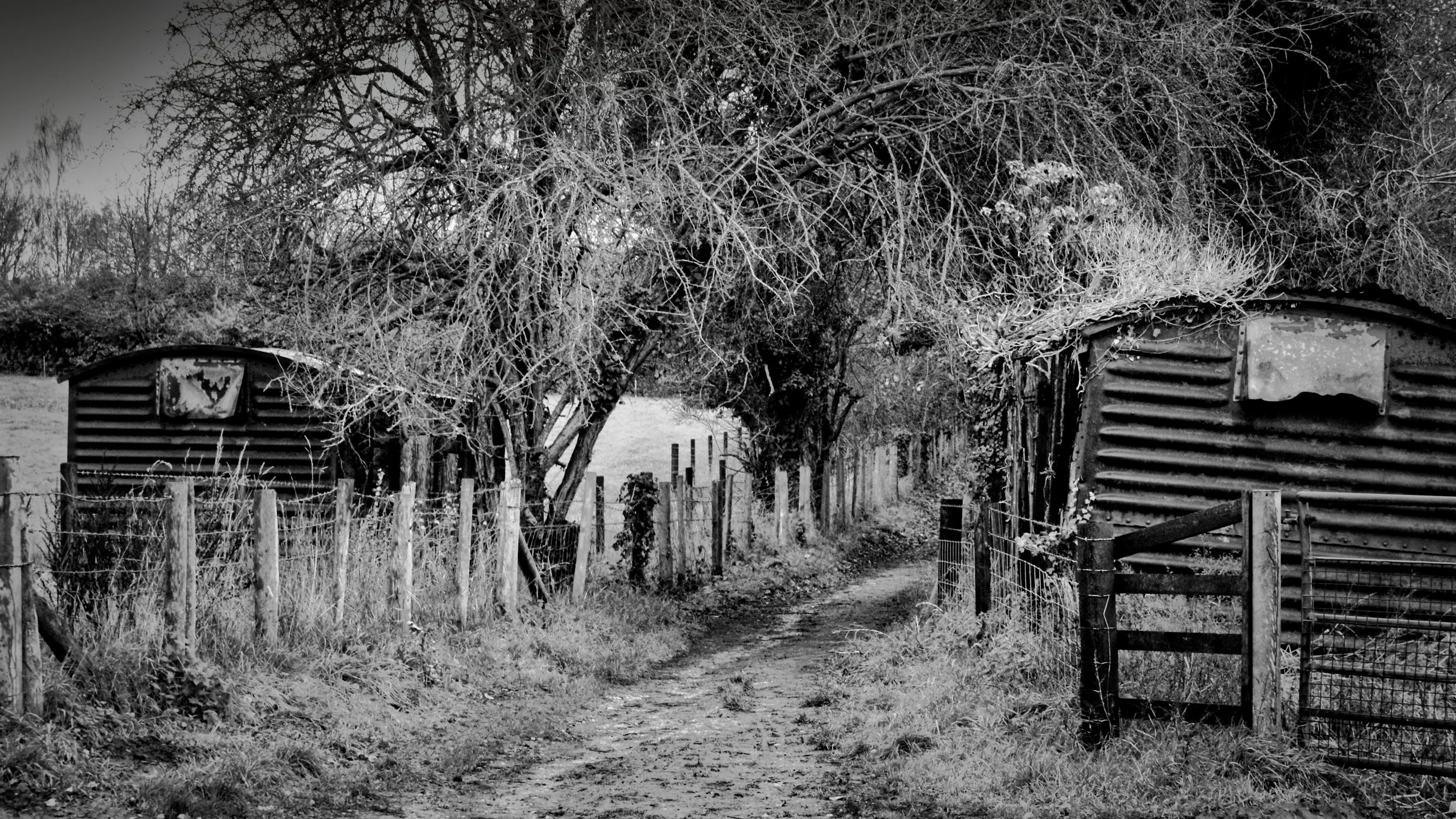
The lane guides you toward the public footpath through Winter Hill Golf Club. Walking across the course feels pleasantly expansive, the fairways stretching out to the right and the views widening once more. At the far end, a set of steps drops you down to a lower path, where you turn left and then right into the field opposite. The descent towards the river has that gentle, rolling feel that makes this part of the loop especially enjoyable. When the Thames finally comes into view, it brings a calming shift in atmosphere, and following its curve round to the left settles you into a peaceful stretch of path leading all the way to Bourne End.
The railway bridge announces the next stage of the journey. The steps up to it are a short, sharp contrast to the otherwise gentle terrain, but the view from the top always feels worth it — the river below, the boats moored along the edges, the water moving slowly through the valley. Crossing the bridge brings you straight into Bourne End, and turning right to pass back underneath it moves you onto the path that leads towards Camden Place.
This small residential street marks the beginning of the homeward leg. Climbing gently up the road, you eventually emerge onto Station Road, where the feel of the walk shifts again. Bourne End has a livelier, more everyday energy than Cookham — the train station, the shops, the movement of people going about their routines. Turning right into Boston Road brings a quieter feel back into the walk, and a short way along you find a footpath on the right. This tucked-away passage leads you through the backs of the houses and out onto Furlong Road.
Turning left and then left again puts you on Cores End Road. Crossing over reveals another hidden footpath, slipping through the hedge and onto the line of an old disused railway. The trackbed becomes a long, straight, satisfying stretch of walking — a corridor of trees and hedges that feels enclosed, yet open enough to keep a steady, relaxed rhythm. It’s the kind of path that pulls you forward without needing to think about direction.
I let Elvis off his lead for one final unhindered run — a chance for joyous, chaotic zoomies. A place where he can follow his ever-inquisitive nose and charge through muddy puddles like a child in new wellies after being told not to.
At the far end, the way forward becomes more complex. A farm gate blocks the direct route, and the path forks: one track rising sharply to the left, the other slipping right through a gap in the hedge between industrial buildings. Taking the right-hand option reconnects you with the edges of Wooburn Green. The main road appears ahead, and turning right brings the finish into sight.
Across the road, partly hidden by hedges and easy to miss, is the footpath that leads back into Wooburn Park. Once you spot the sign and step through, the familiar surroundings return — tennis courts, playing fields, and the quiet sense of coming full circle. The loop closes gently, the walk ending with the same calm ease with which it began.
What makes this route rewarding isn’t just the distance or the scenery, but the way the landscapes shift and reshape around you. It’s a walk of transitions: village to field, woodland to estate, river to railway line, and finally back to the park. Each section brings its own character without ever breaking the flow.
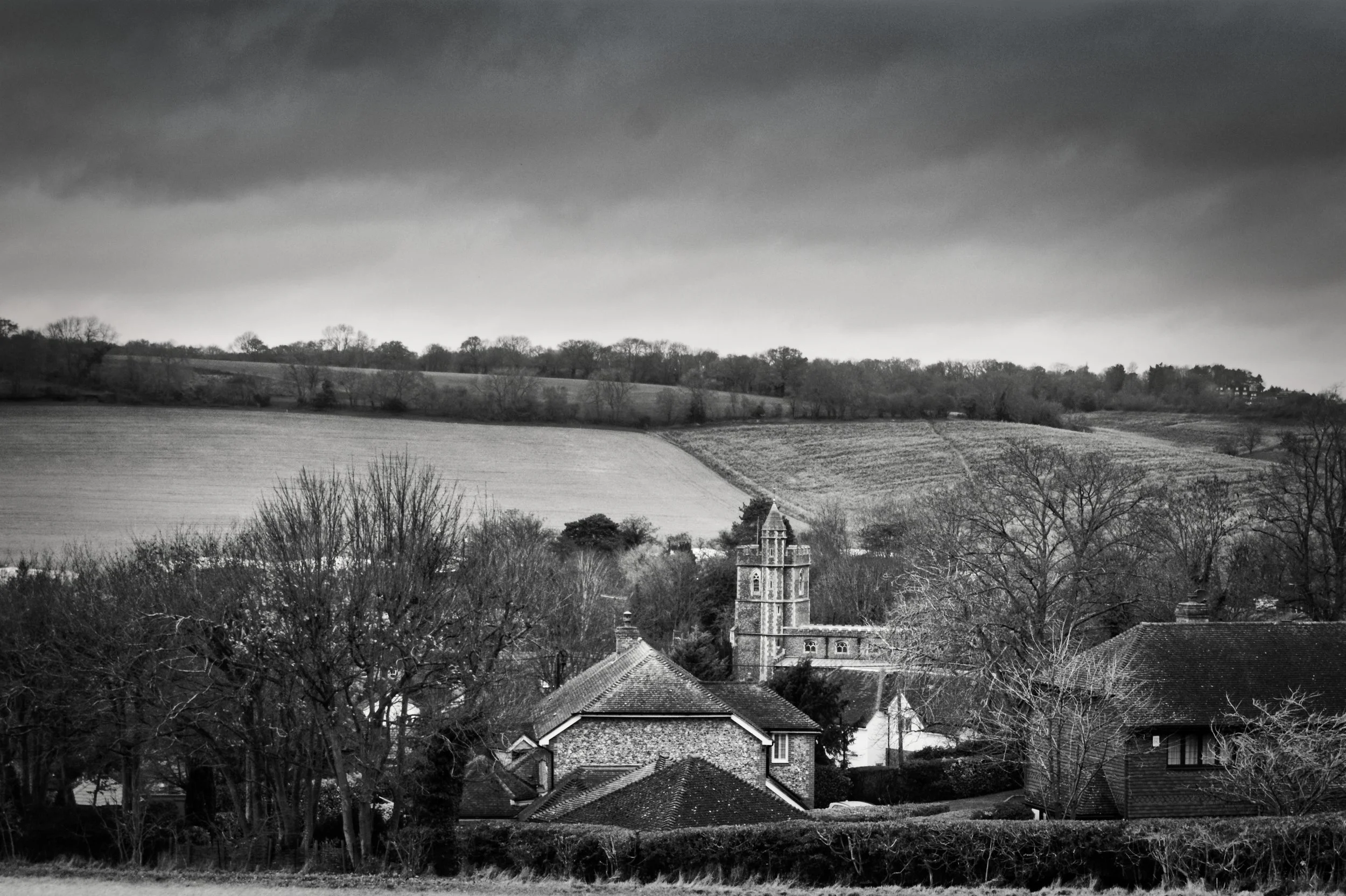
It’s the sort of route you can return to throughout the year and never quite experience the same way twice. The colours shift, the light changes, the Thames rises and falls, and even the villages carry different moods depending on the season. And yet the walk always retains its balance — enough interest to keep you engaged, enough familiarity to feel grounded, and enough space to let the mind settle.
Back at Wooburn Park, the familiar sounds ease back in — a car door closing, voices drifting across the open space, everyday life quietly reclaiming its place. I glance at the time without any real urgency. The Boxing Day window has held. There’s still enough room left in the day for what comes next.
Elvis is muddied, content, and entirely unconcerned by schedules. I feel much the same. The walk has done what it needed to do — clearing the head, slowing things down, and reminding me that even on the busiest days, there’s space to step outside, walk it off, and come back changed just enough to notice.
Full turn-by-turn directions & GPX: Click the button below to open the route in OS Maps.